




Can You Flat-Tow a 2026 Jeep Wrangler Behind a Motorhome Without Damaging the Transmission?
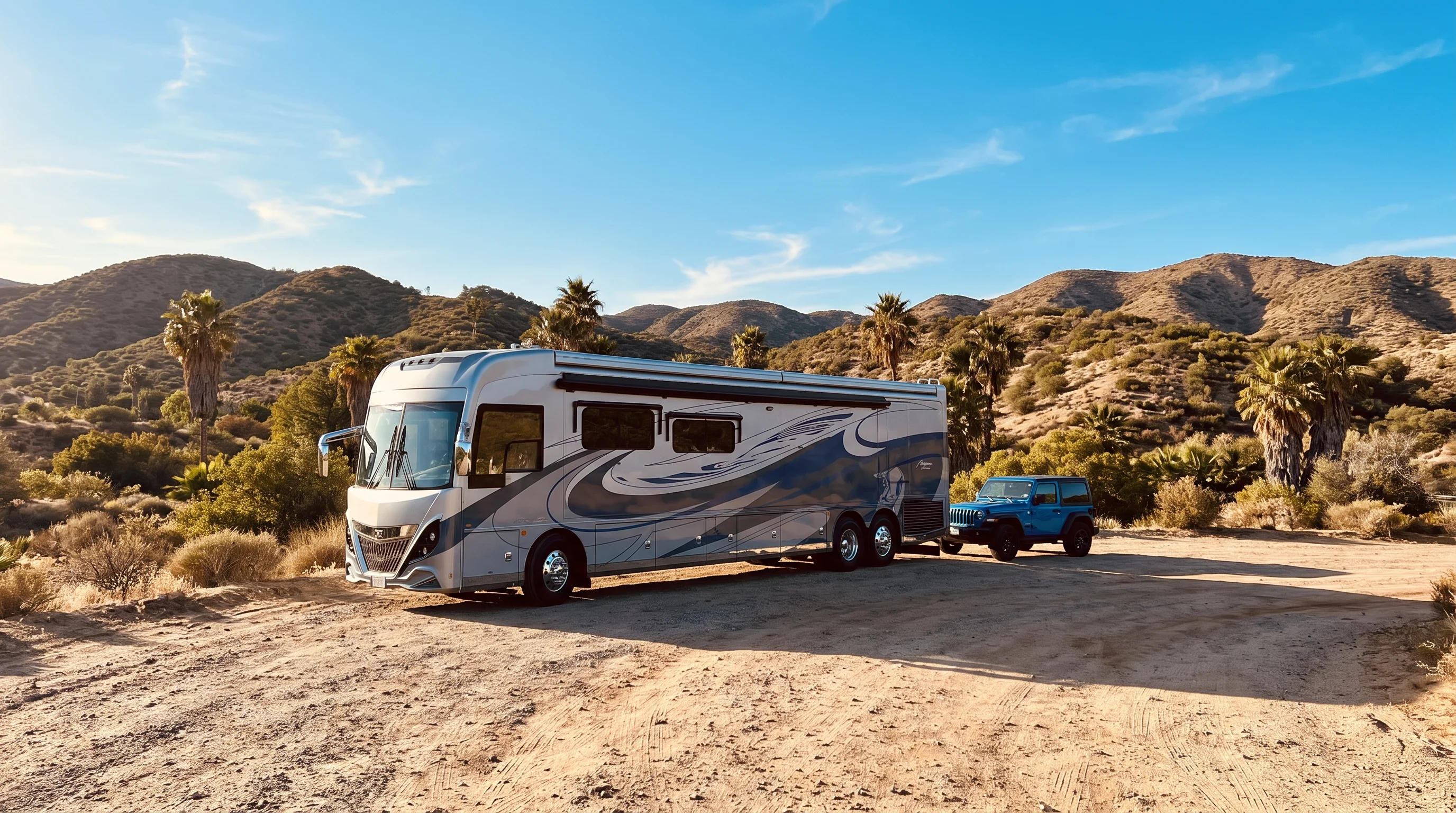
Yes. You can flat-tow a 2026 Jeep Wrangler behind a motorhome without damaging the transmission. The transfer case has to be shifted into Neutral first, following the procedure in the owner’s manual. This is not a workaround. Jeep builds the capability in deliberately. Its own description of the Command-Trac® part-time 4×4 system says so. The 2.72:1 low range is “for rock crawling and neutral for available flat-towing.” Shifting the transfer case into Neutral disconnects the front and rear driveshafts from the transmission output shaft. All four wheels then roll on pavement without spinning internal transmission gearsets or building heat.
The distinction between transfer case Neutral and transmission Neutral is the part owners get wrong. Placing an automatic transmission in Neutral alone does not isolate the drivetrain. Without engine power driving the transmission fluid pump, towing in transmission Neutral can starve internal bearings of oil. That ruins the assembly. Shifting the transfer case into Neutral isolates the transmission entirely. Then put an eight-speed automatic in Park, or a six-speed manual in gear. That locks the transmission output shaft and completes the protection.
FCA’s own recreational towing guidance states the point plainly. Only vehicles with a two-speed transfer case can be flat towed. The transfer case Neutral position disengages both driveshafts. The document also warns that the full shift procedure is necessary to prevent damage to internal parts.
Can Every 2026 Jeep Wrangler Be Flat-Towed Behind an RV?
Every four-wheel-drive 2026 Jeep Wrangler can be flat-towed behind an RV. Every one is built with a two-speed transfer case containing a true mechanical Neutral position. That holds across both body styles and all seven trims.
One change matters for 2026: the Wrangler 4xe plug-in hybrid is no longer in production. Stellantis announced in January 2026 that it was phasing out plug-in hybrid programs in North America beginning with the 2026 model year. The 2026 Wrangler lineup is gasoline-only. Owners of 2021–2025 Wrangler 4xe models still flat-tow using the same transfer case Neutral procedure.
2026 Jeep Wrangler Trims at a Glance
| Trim | Body Style | Standard Engine |
|---|---|---|
| Sport | Two-door or four-door | 3.6L Pentastar® V6 |
| Sport S | Two-door or four-door | 3.6L Pentastar® V6 |
| Willys | Two-door or four-door | 3.6L Pentastar® V6 |
| Sahara | Four-door only | 2.0L Turbo I4 |
| Rubicon | Two-door or four-door | 3.6L Pentastar® V6 |
| Rubicon X | Two-door or four-door | 3.6L Pentastar® V6 |
| Moab 392 | Four-door only | 6.4L HEMI® V8 |
Lineup, engines and 4×4 systems confirmed against the Stellantis “What’s New for 2026: Jeep Wrangler” release.
Engines and Transmissions
The 3.6L Pentastar® V6 produces 285 horsepower and 260 lb-ft of torque. It pairs with either the six-speed manual or the eight-speed automatic. The 2.0L Turbo produces 270 horsepower and 295 lb-ft and is automatic-only. The 6.4L HEMI® V8 in the limited-edition 392 models produces 470 horsepower and 470 lb-ft, also automatic-only.
Hardware differs by trim. The Willys adds 33-inch off-road tires and a Tru-Lok® electronic locking rear differential. The Rubicon adds Tru-Lok® lockers front and rear plus the Rock-Trac® system. None of this changes the flat-tow procedure. The transfer case Neutral position is common to the whole lineup. For a fuller breakdown of how the powertrains differ, see our 2026 Wrangler engine options and specs guide.
Before hooking up any vehicle, confirm the exact recreational towing steps in the owner’s manual for your specific powertrain combination.
What Equipment Is Required to Flat-Tow a Jeep Wrangler Safely?
Flat-towing a Jeep Wrangler safely requires five core components. You need a vehicle-specific base plate or tow-compatible steel bumper, a rated tow bar, safety cables, a towed-vehicle lighting harness, and a supplemental braking system with a breakaway switch. Each works as part of an integrated system that keeps the Jeep attached, legal, and controllable behind the motorhome.
Base Plate / Tow Bumper
Bolts to the frame rails and provides rated anchor points for the tow bar arms.
Tow Bar
Connects the motorhome hitch receiver to the Jeep. Telescoping arms make coupling easier.
Safety Cables
Attach in a crossing pattern beneath the tow bar to catch the assembly if the primary connection fails.
Lighting Harness
A diode kit or plug-in system syncs the Jeep’s brake lights and turn signals with the RV. Rear lighting on the towed vehicle is required.
Supplemental Braking System
Applies the Wrangler’s brakes in proportion to RV deceleration. Includes an emergency breakaway.
The base plate attaches to the Wrangler’s main frame structure, creating receiver points for the tow bar arms. Safety cables cross underneath the tow bar tongue so the assembly is caught if the primary connection lets go.
Supplemental braking is not optional equipment. The weight that triggers a legal brake requirement varies widely by state. Most thresholds land between 1,500 and 5,000 pounds. A Jeep Wrangler sits above every one of them in every configuration. Tow bar makers also specify a supplemental braking system with a breakaway for any towed vehicle, whatever the state minimum.
Maximum towing and payload capacity figures are based on properly equipped vehicles and vary by configuration. Do not exceed any weight rating. See your owner’s manual and the vehicle’s door-jamb label for specific capacities.
Base Plate vs. Aftermarket Tow Bumper: What’s the Difference?
A base plate bolts underneath the factory front bumper onto the frame rails. It provides subtle, removable attachment tabs and preserves a clean daily-driver appearance. An aftermarket tow bumper replaces the factory bumper entirely with heavy-duty steel construction and integrated tow-bar mounting tabs.
Base plates keep a low profile for suburban driving, but they can reduce the front approach angle on technical trails. A steel tow bumper is the opposite trade. It is more aggressive, generally offers better clearance for rock crawling, and brings recovery shackle tabs and winch mounting into the same part.
| Feature | Base Plate | Aftermarket Tow Bumper |
|---|---|---|
| Appearance | Hidden beneath the stock front bumper | Rugged, aggressive full-width or stubby |
| Approach Angle | Can slightly reduce trail clearance | Maximizes clearance for rock crawling |
| Auxiliary Features | Tow points only | Winch plate, D-rings, light bar mounts |
Choosing between them comes down to trail habits and aesthetic preference, not towing performance. Both provide rated attachment points when properly installed.
What Steps Are Required After Putting the Transfer Case in Neutral?
After shifting the Jeep Wrangler transfer case into Neutral, place an automatic transmission into Park or a manual transmission in gear. Then shut off the engine, release the parking brake, and verify the vehicle rolls freely before locking the tow bar arms. Jeep’s owner’s manual is explicit. The transfer case must be in Neutral. An automatic transmission must be in Park. A manual transmission must be in gear, not in Neutral.
The 10-Step Flat-Tow Setup Sequence
Follow this sequence before every trip:
- Position and align. Park the RV and Wrangler on level ground, directly inline with each other.
- Start the engine and apply the brakes. Turn on the Wrangler and hold the foot brake pedal down firmly.
- Shift the transmission to Neutral. Move the automatic or manual shift lever into Neutral.
- Shift the transfer case to Neutral. Move the transfer case lever firmly into Neutral. A brief, deliberate motion prevents gear clash.
- Verify transfer case Neutral. Shift the automatic into Drive or Reverse, or briefly release the clutch on a manual, to confirm no power reaches the wheels.
- Set the final transmission position. Shift the automatic into Park, or place the manual in gear. Any forward gear works. What matters is that it is not left in Neutral.
- Turn the engine off. The steering column on JL-generation Wrangler models does not lock, so the front wheels track freely behind the RV. The steering wheel must remain unlocked at all times while being towed.
- Attach the tow bar hardware. Secure the tow bar arms, safety cables, electrical umbilical, and breakaway lanyard.
- Release the parking brake. Confirm the Wrangler’s parking brake is fully disengaged.
- Test lighting and brakes. Verify brake lights, turn signals, and supplemental braking actuation before pulling onto the road.
Two Rules That Protect the Drivetrain
First, never leave the Wrangler unattended with the transfer case in Neutral. FCA’s recreational towing guidance carries an explicit injury warning on this point, because a vehicle in transfer case Neutral can roll even with the transmission in Park.
Second, do not back up while the vehicles are connected. Tow bar manufacturers are unambiguous about it. Blue Ox instructs owners to disconnect the towed vehicle and stow the tow bar before backing up the motorhome. Reversing while connected can make the towed vehicle jackknife. That puts abnormal stress on the tow bar, chassis, base plate, and hitch. The damage often goes undetected until the next disconnect.
The information in this article is general guidance and does not constitute a specific diagnostic or repair recommendation for any individual vehicle. Repair and maintenance decisions should be made in consultation with a certified technician based on the specific condition of your vehicle.
What Does California Law Require When You Flat-Tow?
California treats a motorhome towing a vehicle differently from one traveling alone. The rules are stricter than the posted signs suggest. Under California Vehicle Code §22406, no passenger vehicle or bus drawing another vehicle may be driven on any highway faster than 55 mph. That applies whether the freeway is posted at 65 or 70. Caltrans also notes that vehicles subject to §22406 must travel in the lanes designated under §21655.
Brake equipment sits in a separate part of the code. Article 1 of Chapter 3 sets the thresholds, and a Jeep Wrangler weighs more than any of them.
| Requirement | What the code says | Section |
|---|---|---|
| Towing speed limit | 55 mph on any highway, regardless of the posted limit | CVC §22406 |
| Lane use | Must travel in the designated lane or lanes | CVC §21655 |
| Brakes on a towed unit | Required on at least two wheels at 3,000 lb gross weight or more | CVC §26302(b) |
| Trailer coaches and camp trailers | Brake threshold drops to 1,500 lb gross weight | CVC §26303 |
| Breakaway | Brakes must apply automatically on breakaway and hold for at least 15 minutes | CVC §26304(a) |
These sections are written around trailers, trailer coaches and camp trailers. They do not spell out how a passenger vehicle towed four wheels down is classified. Confirm your specific setup with the California Highway Patrol or the DMV before your first trip.
This information is provided for general educational purposes only and does not constitute legal advice. Traffic laws and vehicle equipment requirements vary by state and are subject to change. Consult your state highway patrol, your state motor vehicle agency, or a qualified professional for guidance on your individual situation.
Do You Need to Disconnect the Battery When Flat-Towing?
Disconnecting the battery is not part of Jeep’s published flat-tow procedure for JL-generation Wranglers. What specialist RV installers do recommend across the board is a 12-volt charge line from the motorhome to the Jeep. It keeps the Wrangler’s battery topped off on long travel days. It also offsets the draw from a supplemental braking system. If your owner’s manual specifies a battery-disconnect step for your configuration, follow the manual.
The information in this article is general guidance and does not constitute a specific diagnostic or repair recommendation for any individual vehicle. Repair and maintenance decisions should be made in consultation with a certified technician based on the specific condition of your vehicle.
Common Questions About Flat-Towing a Jeep Wrangler
Do I need a drop hitch adapter when connecting my Jeep Wrangler to an RV?
Yes, if the height difference between the motorhome hitch receiver and the Wrangler’s base plate attachment points exceeds three inches. Blue Ox specifies keeping the tow bar as level as possible, with no more than a three-inch height difference between the RV hitch and the base plate, to prevent component strain. Staying within that window avoids binding, nose-diving under braking, and lifting forces on the Jeep’s front suspension.
Can I reverse my motorhome while the Jeep Wrangler is connected via tow bar?
No. Tow bar manufacturers instruct owners to disconnect the towed vehicle before backing up. Reversing even a few feet can cause the Wrangler’s front wheels to turn sharply and the vehicle to jackknife, placing abnormal stress on the tow bar, the chassis, the base plate, and the motorhome’s hitch. Always disconnect before backing up.
How fast can you drive while flat-towing in California?
55 mph. California Vehicle Code section 22406 limits any passenger vehicle or bus drawing another vehicle to 55 mph on any highway, regardless of the posted speed limit, and section 21655 requires those vehicles to use designated lanes. Check your owner’s manual as well, since the manufacturer publishes its own maximum towing speed for the vehicle.
Do I need a supplemental braking system to flat-tow a Wrangler?
Yes. Every Jeep Wrangler configuration weighs more than the weight thresholds that trigger a brake requirement under state law, and tow bar manufacturers specify a supplemental braking system with a breakaway for any towed vehicle regardless of those minimums.
Maximum towing and payload capacity figures are based on properly equipped vehicles and vary by configuration. Do not exceed any weight rating. See your owner’s manual and the vehicle’s door-jamb label for specific capacities.
Does flat-towing affect the Jeep factory warranty coverage?
Flat-towing your Wrangler according to the official owner’s manual procedure does not void your 3-year/36,000-mile basic limited warranty or your 5-year/60,000-mile powertrain limited warranty. Damage resulting from improper transfer case shifting, exceeding weight ratings, or unapproved aftermarket attachments is not covered. Coverage details are published on the Jeep warranty page.
This information is provided for general educational purposes only and does not constitute legal advice. Warranty coverage depends on the specific terms of your vehicle’s warranty agreement. Consult your owner’s manual or a qualified legal professional for guidance on your individual situation.
Prepare Your Jeep Wrangler for RV Adventures
Equipping a 2026 Jeep Wrangler for flat-towing is straightforward once the hardware is right. The shifting sequence becomes routine quickly. Rated tow equipment, the correct transfer case procedure, and a supplemental braking system separate a trouble-free tow from an expensive one. Still deciding which Wrangler fits how you travel? Our 2026 Jeep Wrangler overview covers the lineup in detail. Our 2026 Wrangler trim levels and pricing guide breaks down what each configuration includes. Our team at Fontana Chrysler Dodge Jeep Ram, 16263 S Highland Ave in Fontana, can help you choose. Call our sales team at 909-675-1186 or stop by the showroom.
Disclaimers
Maximum towing and payload capacity figures are based on properly equipped vehicles and vary by configuration. Do not exceed any weight rating. See your owner’s manual and the vehicle’s door-jamb label for specific capacities.
The information in this article is general guidance and does not constitute a specific diagnostic or repair recommendation for any individual vehicle. Repair and maintenance decisions should be made in consultation with a certified technician based on the specific condition of your vehicle.
This information is provided for general educational purposes only and does not constitute legal advice. Warranty coverage depends on the specific terms of your vehicle’s warranty agreement. Consult your owner’s manual or a qualified legal professional for guidance on your individual situation.
This information is provided for general educational purposes only and does not constitute legal advice. Traffic laws and vehicle equipment requirements vary by state and are subject to change. Consult your state highway patrol, your state motor vehicle agency, or a qualified professional for guidance on your individual situation.
0 comment(s) so far on Can You Flat-Tow a 2026 Jeep Wrangler Behind a Motorhome Without Damaging the Transmission?