






What Is eSave Mode in a Jeep 4xe and How Does It Work?
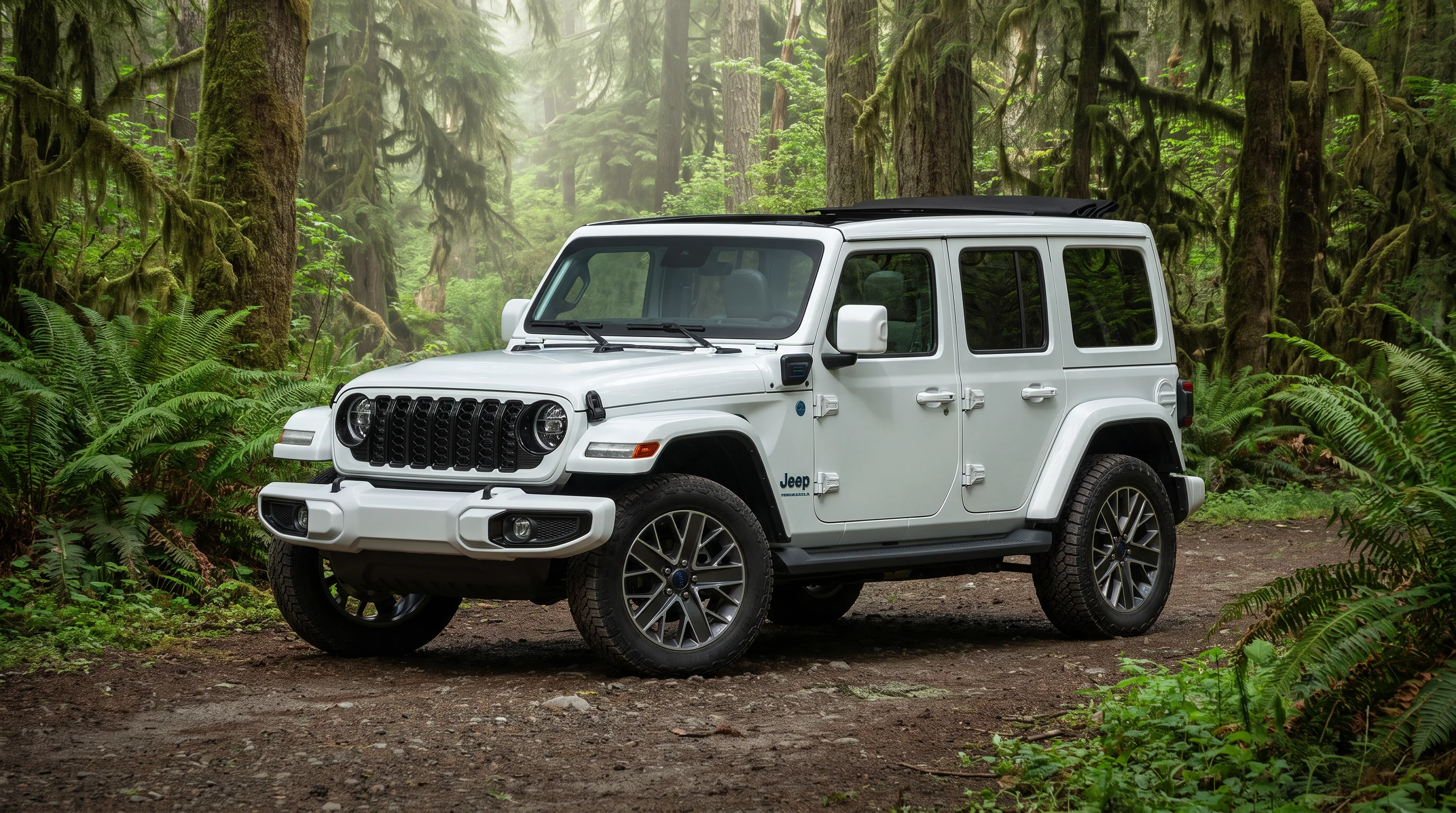
eSave Mode in a Jeep 4xe is an E Selec driving setting that prioritizes the 2.0-liter turbocharged four-cylinder engine for propulsion. That preserves the high-voltage battery’s state of charge for later use. By relying primarily on gas power, eSave lets drivers hold electric range for specific scenarios like low-speed trail driving or city commuting.
One thing worth knowing up front: Jeep no longer builds the 4xe. Stellantis is phasing out plug-in hybrid programs in North America beginning with the 2026 model year. That made 2025 the final model year for both the Wrangler 4xe and the Grand Cherokee 4xe. The guidance below applies to the 2021-2025 vehicles already on the road, and those models still turn up in our pre-owned inventory.
The Jeep 4xe plug-in hybrid powertrain combines a 2.0L turbocharged inline-four with two motor generators. One is engine-mounted and replaces the alternator. The other is transmission-mounted and replaces the torque converter. Energy is stored in a 400-volt, 17-kWh lithium-ion battery pack. When you start a Wrangler 4xe or Grand Cherokee 4xe, the system defaults to Hybrid Mode. It blends electric and combustion power automatically. Pressing the eSave button on the E Selec panel overrides that default. The system then draws its primary power from the engine.
eSave is one of three settings on that panel, and it helps to see how all three relate before digging into this one. Our guide to the Jeep 4xe driving modes walks through Electric, Hybrid, and eSave side by side.
For drivers heading north toward the Cajon Pass, holding high-voltage battery power in reserve means arriving with electric range still available. Using gas power on open highway stretches saves battery capacity for quiet, high-torque low-speed driving at your destination.
What Is the Difference Between Battery Save and Battery Charge?
eSave gives you two sub-settings, and the difference is whether the engine simply preserves the battery energy you already have or actively adds more. Battery Save holds your current state of charge. Battery Charge uses the engine to turn the engine-mounted motor generator, feeding electrical energy back into the pack as you drive.
Battery Charge consumes somewhat more fuel per mile, since the engine is doing two jobs at once. It earns its keep when you are heading toward an off-road park or a low-emission zone without access to a charging station along the way.
Battery Save
What the engine does: Propels the vehicle.
Effect on the battery: Holds your current charge.
Fuel use: Lower.
When it fits: Saving charge for later in the drive.
Battery Charge
What the engine does: Propels the vehicle and drives the motor generator.
Effect on the battery: Adds charge as you drive.
Fuel use: Somewhat higher.
When it fits: Building charge before you arrive.
You select between the two inside the Hybrid Electric Pages on the Uconnect touchscreen.
How Do You Turn On eSave Mode in a Jeep 4xe?
You turn on eSave by pressing the eSave button on the E Selec control panel, located on the instrument panel to the left of the steering wheel. You adjust between Battery Save and Battery Charge through the Hybrid Electric Pages on the Uconnect center screen.
- Locate the three E Selec buttons, labeled Hybrid, Electric, and eSave, on the instrument panel to the left of the steering wheel.
- Press the eSave button once while the vehicle is running.
- Open the Uconnect center screen and navigate to the Hybrid Electric Pages.
- Choose Battery Save to hold your current charge, or Battery Charge to rebuild charge using engine power.
Does eSave Mode Affect Horsepower or Towing Capacity?
A Jeep 4xe’s published power and towing figures are properties of the vehicle, not of the drive mode you select. E Selec governs how the powertrain manages battery charge; it does not re-rate the powertrain. Both 4xe models share the same 375-horsepower, 470 lb-ft system output and the same 17-kWh battery, and they differ on electric range and maximum towing.
| Spec | Wrangler 4xe | Grand Cherokee 4xe |
|---|---|---|
| System horsepower | 375 hp | 375 hp |
| System torque | 470 lb-ft | 470 lb-ft |
| Battery | 17 kWh | 17 kWh |
| All-electric range | EPA-Estimated 21-22 miles (varies by trim) | EPA-Estimated 26 miles |
| Max towing, properly equipped | 3,500 lbs | 6,000 lbs |
Maximum towing and payload capacity figures are based on properly equipped vehicles and vary by configuration. Do not exceed any weight rating. See your owner’s manual and the vehicle’s door-jamb label for specific capacities.
EPA-estimated fuel economy figures are for comparison purposes only. Your actual mileage will vary depending on driving conditions, how you drive and maintain your vehicle, battery age/condition, and other factors.
Because heavy towing places sustained demand on the powertrain, many owners run eSave on long highway stretches so that battery reserves are still available when the grade steepens.
Can You Use eSave on the Highway and Off-Road?
Yes. eSave suits both high-speed cruising and technical trail driving, for the same underlying reason: it lets you choose where your electric range gets spent.
On the Highway
On the highway, combustion engines operate near their efficiency sweet spot. Running eSave at highway speeds reserves your all-electric driving range for the stop-and-go streets where electric power works best. In a Wrangler 4xe that range is an EPA-Estimated 21 to 22 miles, depending on trim. Drivers running the Interstate 10 corridor through West Covina can let the engine handle the freeway miles and keep electric power for city driving later in the trip.
EPA-estimated fuel economy figures are for comparison purposes only. Your actual mileage will vary depending on driving conditions, how you drive and maintain your vehicle, battery age/condition, and other factors.
On the Trail
Off-road, eSave lets you conserve battery energy during the paved drive to the trailhead. Once you reach the dirt, switching E Selec to Electric or Hybrid puts that saved charge to work. Electric power on the trail offers:
Instant Torque
Low-end pull for control when crawling over rocks and obstacles.
Near-Silent Running
Quiet trail operation at low speeds.
Fewer Emissions
Reduced exhaust output during low-speed driving.
Precise Throttle
Fine control without high engine revs to build torque.
Shopping for what replaced it? The gas Wrangler carries the lineup forward, and our 2026 Jeep Wrangler engine options and specs guide covers the current powertrain choices.
Common Questions About Jeep 4xe eSave Mode
What is the fuel economy rating for a Jeep Wrangler 4xe?
The Wrangler 4xe carries an EPA-Estimated 49 MPGe combined when using both electric and gasoline power. Running on gasoline alone after the battery charge is depleted, it returns an EPA-Estimated 20 mpg combined.
EPA-estimated fuel economy figures are for comparison purposes only. Your actual mileage will vary depending on driving conditions, how you drive and maintain your vehicle, battery age/condition, and other factors.
Can you use eSave Mode when the Jeep 4xe battery is depleted?
Yes. eSave can be engaged even when the cluster shows no remaining electric range. Regenerative braking continues to route energy that would otherwise be lost back into the battery pack, and selecting Battery Charge directs the engine to rebuild battery reserves while you drive.
What is the difference between Hybrid Mode and eSave Mode?
Hybrid Mode is the default. It blends engine and electric motor torque, drawing on battery power first and bringing in the engine once the battery reaches its minimum state of charge. eSave reverses that priority, leaning on the engine so the battery’s remaining charge is held for later. Hybrid Mode spends the battery for efficiency; eSave protects it for a specific stretch of driving you have in mind.
How long does it take to charge a Jeep 4xe battery at home?
On a 240-volt Level 2 home charger, a full charge takes roughly two to three hours.
Charging times are estimates. The U.S. Department of Transportation’s charger types and speeds guidance notes that Level 2 equipment charges a battery-electric vehicle to 80 percent from empty in 4 to 10 hours, while Level 1 can take 40 to 50 or more hours. Your results will vary by vehicle and equipment.
Living With a Jeep 4xe
eSave gives you real control over your 4xe powertrain, letting you decide when to burn gasoline and when to deploy electric power. Understanding E Selec is what separates getting by from getting the most out of a plug-in hybrid. That holds whether you are optimizing a long highway commute or saving charge for quiet low-speed trail work.
Our team at Fontana Chrysler Dodge Jeep Ram knows these vehicles. Own a 4xe and want a walkthrough of the Hybrid Electric Pages? Shopping our pre-owned 4xe inventory? We are at 16263 S Highland Ave, Fontana, CA 92336. You can reach our sales team at (909) 675-1186.
Disclaimers
Maximum towing and payload capacity figures are based on properly equipped vehicles and vary by configuration. Do not exceed any weight rating. See your owner’s manual and the vehicle’s door-jamb label for specific capacities.
EPA-estimated fuel economy figures are for comparison purposes only. Your actual mileage will vary depending on driving conditions, how you drive and maintain your vehicle, battery age/condition, and other factors.
Charging times are estimates. The U.S. Department of Transportation’s charger types and speeds guidance notes that Level 2 equipment charges a battery-electric vehicle to 80 percent from empty in 4 to 10 hours, while Level 1 can take 40 to 50 or more hours. Your results will vary by vehicle and equipment.
0 comment(s) so far on What Is eSave Mode in a Jeep 4xe and How Does It Work?