




How Often Should You Change the Oil and Oil Filter in a Ram 3500 Cummins Diesel?
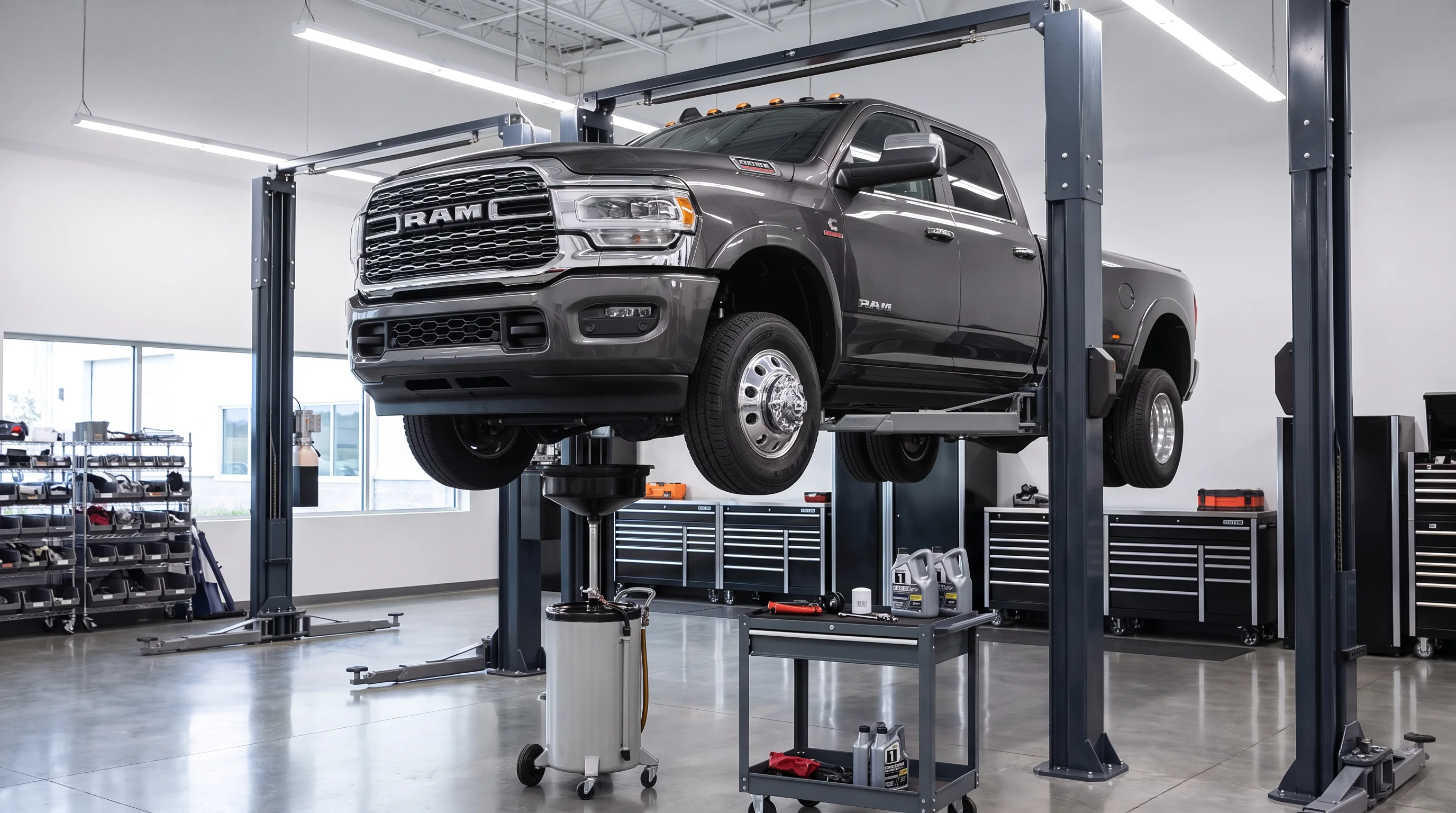
Ram specifies changing the engine oil and oil filter in a Ram 3500 with the 6.7L Cummins Turbo Diesel every 15,000 miles, 12 months, or 500 engine hours — whichever comes first. Change it sooner if the oil change indicator asks for it. That last clause does more work than the numbers do. The indicator is not a mileage countdown; it watches how the engine has actually been worked and will often ask for service well before the odometer reaches 15,000.
Service Interval Quick Reference
These are the figures published in the Ram 2500/3500 owner’s manual maintenance plan for the 6.7L diesel.
| Service item | Interval — whichever comes first | Notes |
|---|---|---|
| Engine oil and oil filter | 15,000 mi / 12 months / 500 engine hours | Or sooner if the oil change indicator prompts |
| Front engine-mounted fuel filter | 15,000 mi / 12 months | 3-micron rating; replaced alongside the rear filter at each oil change |
| Rear engine-mounted fuel filter | 15,000 mi / 12 months | 5-micron rating; replaced alongside the front filter at each oil change |
| Operation on more than 5% biodiesel | 15,000 mi / 500 engine hours / 6 months | The 6-month ceiling is shorter than the standard 12 months |
The information in this article is general guidance and does not constitute a specific diagnostic or repair recommendation for any individual vehicle. Repair and maintenance decisions should be made in consultation with a certified technician based on the specific condition of your vehicle.
What the Oil Change Indicator Is Actually Measuring
Ram’s oil change indicator system is duty-cycle based, which means the interval it calculates shifts with how the truck is driven. Engine load, operating temperature and run time all feed the calculation. Two identical trucks on the same odometer reading can land in very different places on the percentage readout.
Engine hours are the part owners most often overlook. A truck idling at a job site accumulates hours against the 500-hour ceiling without adding a single mile to the odometer. For work trucks that spend real time stationary, the hour limit frequently arrives first — and the oil still needs to be changed when it does.
Which Oil the 6.7L Cummins Requires
The oil specification changed with the 2019 engine redesign, and this is the single most consequential thing to get right on a Cummins.
| Model year | Ambient temperature | Viscosity | Specification |
|---|---|---|---|
| 2019 and newer | Above 0°F | 10W-30 | API CK-4 required; Material Standard MS-10902. Cummins CES 20081 also acceptable |
| 2019 and newer | Below 0°F | 5W-40 synthetic | API CK-4 required; Material Standard MS-10902. Cummins CES 20081 also acceptable |
| 2018 and older | Above 0°F | 15W-40 | API CJ-4; Material Standard MS-10902 |
| 2018 and older | Below 0°F | 5W-40 synthetic | API CJ-4; Material Standard MS-10902 |
Why 15W-40 Is No Longer Allowed
15W-40 cannot be used in any 2019-or-newer 6.7L Cummins. The manufacturer’s technical bulletin on 6.7L oil usage states that the redesigned valve train will form deposits in the hydraulic valve lash adjusters if 15W-40 is used, leading to undesirable noise and potential engine damage. This is worth checking even if someone else has been servicing the truck — 15W-40 remains the default diesel oil on a lot of shelves, and it was the correct answer for these engines right up through 2018.
5W-40 synthetic is the recommendation where temperatures fall below 0°F. It is also safe to run in warmer conditions. That makes it the simplest single choice if you would rather not switch viscosities seasonally.
Oil Capacity
The 6.7L Cummins holds 12 quarts (11.4 liters) with a filter change. Always confirm the final level on the dipstick after filling rather than trusting the jug count. For off-road use, the manual specifies setting the level at the full mark on the dipstick.
Oil Filters
Oil filter part numbers are not consistent across the life of this engine. The filter specified for a late-model truck is not the one that fits an older one, and cross-references published for one generation do not carry forward. Rather than ordering from a number found online, give our parts department your VIN and they will match the correct filter to your truck.
What Shortens the Interval
The 15,000-mile figure is a ceiling for normal operation, not a target for a working truck. The owner’s manual names six severe-service conditions that may reduce oil change intervals: high ambient temperature, short trips, heavy loading, trailer towing, off-road use and law enforcement use. Ram does not publish a separate fixed mileage for severe duty. The indicator shortens the interval instead.
| Operating condition | Effect on the engine oil |
|---|---|
| Trailer towing and heavy loading | Raises oil temperature under sustained load, accelerating thermal breakdown |
| High ambient temperature | Adds heat the cooling system must shed before it reaches the oil |
| Short trips | Engine never fully reaches operating temperature, so moisture and fuel are not driven off |
| Extended idling | Accumulates engine hours with no miles, and incomplete combustion increases soot and fuel dilution |
| Off-road and dusty operation | Increases airborne contamination reaching the intake and crankcase |
Diesels generate fine soot as a normal product of combustion, and the oil holds those particles in suspension to keep internal surfaces clean. As soot loading climbs, the oil’s shear stability and additive package degrade. The practical rule: when the cluster asks for service, book it, even if the odometer says you have miles left.
Resetting the Oil Change Indicator
An authorized dealer resets the oil change indicator as part of a scheduled oil change. If the service is performed elsewhere, consult your owner’s manual for the reset procedure for your model year, because the menu path has changed across generations.
One thing never to do: reset the indicator without actually changing the oil and filter. The system then tracks degradation from a false starting point and leaves soot-loaded oil in service well past its usable life.
What Happens If You Delay Service
Running past the interval exposes hardware that is expensive to replace:
- Soot and sludge accumulation — oil that can no longer hold particles in suspension drops them into oil galleries, timing gear and the oil pump pickup screen.
- Turbocharger bearing wear — the turbocharger is lubricated by engine oil. Thermal breakdown leaves carbon deposits in the oil feed lines, restricting flow to bearings that depend on it.
- Valve train wear — viscosity loss thins the protective film between camshaft lobes and their followers, allowing metal-to-metal contact.
- Warranty exposure — manufacturers require proof that a vehicle was serviced on the published intervals before approving a powertrain claim. Keep itemized receipts showing date, mileage and work performed.
This information is provided for general educational purposes only and does not constitute legal advice. Warranty coverage depends on the specific terms of your vehicle’s warranty agreement. Consult your owner’s manual or a qualified legal professional for guidance on your individual situation.
Fuel Filters Are Replaced on the Same Visit
Current Ram HD trucks use two engine-mounted fuel filter assemblies, mounted side by side on the driver side of the engine. Ram’s schedule replaces both at the same 15,000-mile interval as the oil. That is why they are normally handled in a single appointment. The front filter must meet a 3-micron rating and the rear a 5-micron rating, so the two are not interchangeable. Earlier model years used a chassis-mounted filter instead of the rear engine-mounted one, which is why older guidance describes a different layout.
Replacing only one of the two leaves the system exposed, since a restricted filter forces the lift pump to work harder and can set a low fuel-rail-pressure code.
Between services, drain accumulated water from the fuel/water separator whenever the Water In Fuel indicator illuminates. The manual cautions against draining the separator while the engine is running. For the full filtration picture, see our 6.7L Cummins diesel maintenance guide.
Common Questions About Ram 3500 Cummins Oil Service
How often should you change the oil in a Ram 3500 Cummins diesel?
Under normal operating conditions, every 15,000 miles, 12 months, or 500 engine hours, whichever comes first, or sooner if the oil change indicator prompts you. The indicator is duty-cycle based and will frequently call for service before the mileage ceiling under heavy towing, idling or dusty operation.
Can you use 15W-40 oil in a 6.7L Cummins?
Only in 2018-and-older engines. For 2019-and-newer 6.7L Cummins engines, 15W-40 cannot be used because the redesigned valve train will form deposits in the hydraulic valve lash adjusters, causing noise and potential engine damage. Use 10W-30 meeting API CK-4 above 0 degrees Fahrenheit, or 5W-40 synthetic below 0 degrees Fahrenheit.
How much oil does the 6.7L Cummins hold?
The 6.7L Cummins Turbo Diesel holds 12 quarts (11.4 liters) with a filter change. Confirm the final level on the dipstick after filling.
Do engine hours count toward the oil change interval?
Yes. The 500-hour limit applies alongside the 15,000-mile and 12-month limits, and whichever arrives first governs. Hours accumulate during idling without adding miles, so trucks that spend significant time stationary at job sites often reach the hour limit well before the mileage limit.
How often should the diesel fuel filters be replaced?
Both fuel filters are replaced every 15,000 miles or 12 months, on the same schedule as the oil and oil filter. Current trucks carry two engine-mounted filters, a 3-micron front filter and a 5-micron rear filter, and they are replaced together rather than individually.
Does running biodiesel change the oil change interval?
Yes. If the truck operates on blends above 5% biodiesel, the oil change interval must not exceed 15,000 miles or 500 engine hours, and the time limit tightens from 12 months to 6 months. Failing to meet those requirements on biodiesel blends can cause premature engine wear that is not covered by the New Vehicle Limited Warranty.
Schedule Cummins Diesel Service at Fontana Chrysler Dodge Jeep Ram
Heavy-duty diesel service takes the right fluids, the right filters and technicians who work on these engines regularly. Our factory-trained team at Fontana Chrysler Dodge Jeep Ram handles oil and filter changes, dual fuel filter replacement and multi-point inspections. We serve Ram HD owners across Fontana, Rancho Cucamonga, San Bernardino, Claremont, West Covina and Riverside.
Our service center is located at 16263 S Highland Ave, Fontana, CA 92336. Book online or call our service desk at 909-675-1927.
Disclaimers
The information in this article is general guidance and does not constitute a specific diagnostic or repair recommendation for any individual vehicle. Repair and maintenance decisions should be made in consultation with a certified technician based on the specific condition of your vehicle.
This information is provided for general educational purposes only and does not constitute legal advice. Warranty coverage depends on the specific terms of your vehicle’s warranty agreement. Consult your owner’s manual or a qualified legal professional for guidance on your individual situation.