





Ram 1500 vs. Ram 2500: Which Truck Fits Your Inland Empire Workload?
Choosing between the light-duty 2026 Ram 1500 and the heavy-duty 2026 Ram 2500 comes down to balancing your everyday driving needs against your maximum capability requirements. Both trucks deliver cabin comfort, modern technology, and rugged dependability for workdays and weekends alike. This comparison helps you determine which model fits your driveway, your family, and your specific hauling demands.
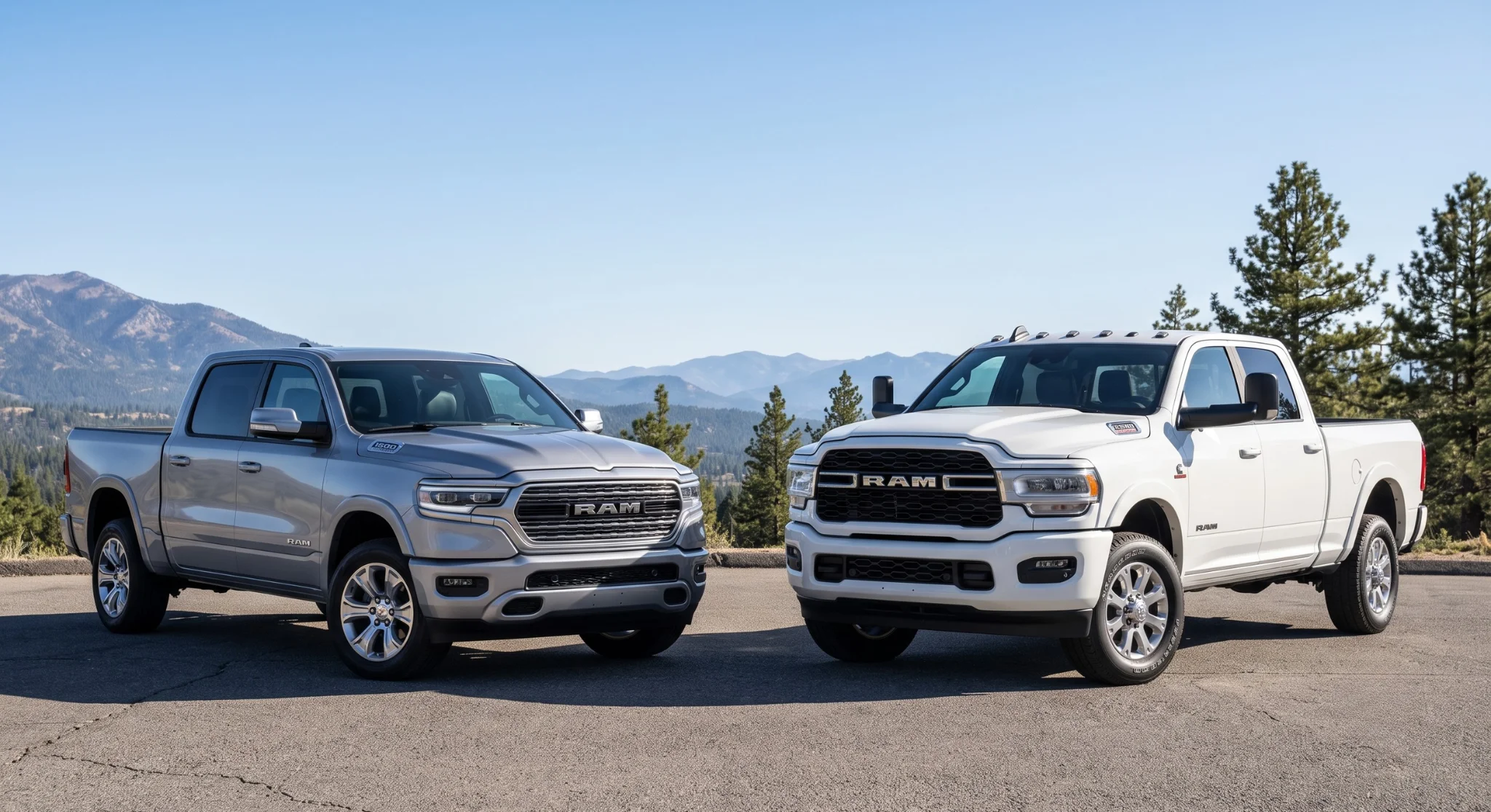
Why Fontana Drivers Weigh the 2026 Ram 1500 Against the Ram 2500
Many shoppers walk into our showroom unsure whether they need a light-duty or heavy-duty pickup. The answer usually comes down to how you use the truck during the workweek. For professionals in Fontana’s logistics and manufacturing sectors, a truck isn’t just transportation — it’s a tool for the job.
Here’s the quick way to sort it out:
- Choose the Ram 2500 if your routine involves transporting heavy machinery, hauling industrial components, or working demanding commercial jobsites. Its heavy-duty chassis is engineered to handle continuous strain, making it a favorite among local contractors and fleet operators.
- Choose the Ram 1500 if your truck pulls double duty as a family vehicle and weekend adventure machine. It delivers smoother ride quality, easier maneuverability in tight parking areas, and plenty of capability for towing recreational toys or hauling home-improvement supplies.
Capability at a Glance
| Specification | 2026 Ram 1500 | 2026 Ram 2500 |
|---|---|---|
| Class | Light-duty (½-ton) | Heavy-duty (¾-ton) |
| Standard engine | 3.6L Pentastar V6 (305 hp) | 6.4L HEMI® V8 (405 hp) |
| Top available engine | High-Output 3.0L Hurricane I6 (540 hp) | 6.7L Cummins® Turbo Diesel I6 (430 hp / 1,075 lb-ft) |
| Max towing (properly equipped) | Up to 11,610 lbs | Up to 20,000 lbs |
| Max payload (properly equipped) | Up to 2,360 lbs | Up to 4,580 lbs |
| Rear suspension | Link-coil (available air) | Five-link coil (available auto-leveling air) |
Maximum towing and payload capacity figures are based on properly equipped vehicles and vary by configuration. Do not exceed any weight rating. See your owner’s manual and the vehicle’s door-jamb label for specific capacities.
The takeaway: the Ram 1500 covers the vast majority of everyday towing — boats, campers, utility trailers — while the Ram 2500 exists for drivers who regularly pull fifth-wheels, gooseneck trailers, or heavy equipment near the truck’s upper limits.
Cargo Space and Passenger Comfort
Both trucks offer spacious crew-cab configurations with generous legroom and headroom front and rear. Whether you’re carpooling to a jobsite or heading toward the foothills near Claremont for a weekend hike, passengers have room to stretch out. Where the two trucks part ways is ride character.
2026 Ram 1500
The Ram 1500 uses a link-coil rear suspension — with available four-corner air suspension — that delivers a smooth, composed ride and absorbs pavement imperfections well. It also sits slightly lower than its heavy-duty sibling, making entry and exit easier for kids and older passengers. For daily commuting and family road trips, the 1500 offers the more relaxed experience.
2026 Ram 2500
The Ram 2500 rides on a heavy-duty five-link coil rear setup tuned to support massive payloads. It’s remarkably composed for a three-quarter-ton truck, but firmer when the bed is empty. That firmness is the trade-off for the reinforced chassis that lets it carry and pull far more than a light-duty truck.
Performance and Driving Experience
Ram 1500: Tuned for Agility
- Steering & handling: Precise, with a footprint that makes it easy to park and navigate.
- Power delivery: Engine lineup from the Pentastar V6 to the returning 5.7L HEMI® V8 and the Hurricane inline-six family.
- Best at: Quick, smooth acceleration for highway merging and city driving.
Ram 2500: Built to Pull
- Steering & handling: Weighted for heavy loads, with a planted, stable feel under load.
- Braking: Upsized for confident stops when towing near capacity.
- Best at: Pulling heavy gear up steep grades like the Cajon Pass, backed by the Cummins® diesel’s 1,075 lb-ft of torque.
| Driving Priority | Better Fit |
|---|---|
| Daily driving, parking, city commuting | Ram 1500 |
| Lighter, occasional towing | Ram 1500 |
| Sustained heavy hauling & steep grades | Ram 2500 |
| Maximum stability under a loaded trailer | Ram 2500 |
Fuel Efficiency and Range
The 2026 Ram 1500 is engineered with weight-saving materials, aerodynamic active grille shutters, and efficient engine options that help maximize EPA-Estimated fuel economy in highway and stop-and-go driving — making the light-duty model the clear efficiency winner. The Ram 2500, as a heavy-duty vehicle built for maximum work output, uses heavier components that require more energy to move; it isn’t EPA fuel-economy rated, but its large fuel tank delivers strong driving range on long hauls.
Fuel Economy, Tank Capacity & Range
| Measure | 2026 Ram 1500 | 2026 Ram 2500 |
|---|---|---|
| EPA-Estimated MPG — base engine | 20 / 25 / 22 (3.6L Pentastar V6, 2WD) | Not EPA-rated (heavy-duty, over 8,500 lbs GVWR) |
| EPA-Estimated MPG — standard-output turbo I6 | 18 / 25 / 21 (3.0L Hurricane I6, 2WD) | Not EPA-rated |
| EPA-Estimated MPG — V8 | 16 / 20 / 18 (5.7L HEMI® V8, 4WD) | Not EPA-rated |
| EPA-Estimated MPG — high-output engine | 15 / 21 / 17 (HO 3.0L Hurricane I6, 4WD) | Not EPA-rated |
| Standard fuel tank | 26 gallons | 31 gallons |
| Available fuel tank | 33 gallons | 50 gallons (Crew Cab, 8-ft bed) |
| Approx. highway range (unloaded) | Up to ~800 miles (33-gal tank, efficient engines) | Over 800 miles (50-gal tank, Cummins® diesel) |
MPG figures shown are EPA-Estimated for the Ram 1500. Heavy-duty trucks over 8,500 lbs GVWR, including the Ram 2500, are exempt from EPA fuel-economy testing, so no comparable window-sticker MPG figure is published. For drivers who prioritize efficiency on daily errands and family trips, the 1500 is the more economical choice; the 2500 trades day-to-day MPG for the fuel capacity and range its work demands.
EPA-estimated fuel economy figures are for comparison purposes only. Your actual mileage will vary depending on driving conditions, how you drive and maintain your vehicle, battery age/condition, and other factors.
Safety and Driver Assistance
Both trucks offer a robust suite of safety technology, with each lineup emphasizing the scenarios its drivers face most.
Ram 1500
- Forward collision warning
- Blind-spot monitoring with trailer detection
- Lane-keeping assist
These act as an extra set of eyes for heavy traffic and tight highway lanes, and they’re tuned to feel less intrusive during everyday suburban driving.
Ram 2500
- Specialized camera views for the bed and behind a trailer
- Integrated trailer brake controller
- Trailering-focused driver assistance
The 2500’s safety tech leans into towing confidence — helping you monitor and control what’s behind you under heavy load.
Both trucks deliver strong crash protection built into their reinforced structures.
Ownership Confidence
Both the Ram 1500 and Ram 2500 are backed by a comprehensive manufacturer warranty package that protects your investment for years. Here’s what that means for Inland Empire ownership:
- Warranty coverage: Both trucks carry a comprehensive manufacturer warranty package that protects your investment over the long term.
- Climate-smart maintenance: These trucks work hard in the Inland Empire’s warm, semi-arid climate, so staying current on scheduled maintenance helps prevent premature wear on critical engine and transmission components.
- Resale strength: Consistent upkeep helps preserve the strong resale value Ram trucks are known for.
- Guided selection: Our team can help you weigh trims, powertrains, and financing to match the truck to your workload.
Warranty coverage depends on the specific terms of your vehicle’s warranty agreement. See dealer for details.
For more head-to-head guides, visit our Chrysler, Dodge, Jeep & Ram research hub.
Frequently Asked Questions: Choosing Between the 2026 Ram 1500 and Ram 2500
Is the 2026 Ram 1500 strong enough to tow a recreational camper?
Yes. The 2026 Ram 1500 offers competitive towing capacity — up to 11,610 pounds when properly equipped — which is more than sufficient for most standard travel trailers, boats, and utility trailers. It’s an excellent choice for weekend camping trips.
Which truck is easier to park in suburban areas?
The 2026 Ram 1500 is significantly easier to maneuver and park. It has a shorter overall length, a narrower body, and a tighter turning radius than the heavy-duty Ram 2500.
Does the Ram 2500 offer a comfortable ride for daily driving?
The Ram 2500 is remarkably comfortable for a heavy-duty truck, but its suspension is tuned to carry heavy loads. When the bed is empty, the ride feels firmer than the link-coil ride tuning of the Ram 1500.
Where can I test drive these trucks to compare them in person?
You can experience both models at our showroom at 16263 S Highland Ave, Fontana, CA 92336. If you have questions about current inventory or want to speak with a truck specialist, give our team a call today.
Which Ram Truck Belongs in Your Driveway?
Both trucks deliver outstanding capability, but they serve different purposes. The heavy-duty Ram 2500 is an exceptional workhorse for demanding jobsites and maximum towing. For the majority of buyers, though, the 2026 Ram 1500 is the stronger all-around choice — blending daily drivability, family comfort, modern safety technology, and better fuel efficiency without sacrificing rugged capability. Explore our new-vehicle inventory to find the right fit, and when you’re ready, streamline the process by applying for financing online.
Manufacturer’s Suggested Retail Price (MSRP) for new vehicles includes manufacturer and distributor options and delivery, process and handling fees, which may be subject to change at any time. MSRP excludes taxes, title, license and dealer installed options, accessories, fees and charges. MSRP is not the dealer advertised price. Dealer price will vary. The dealer sets the final price.