




2026 Jeep Gladiator vs. 2026 Jeep Wrangler: Which Is Right for You?
Choosing between the 2026 Jeep Gladiator and the 2026 Jeep Wrangler comes down to one question: do you need the open-bed utility of a truck, or the compact footprint of an SUV? Both share the same legendary 4×4 DNA — removable doors, folding windshield, real trail capability — but they are built for different lives. This side-by-side breaks down price, space, performance, efficiency, and technology so Inland Empire drivers can decide which Jeep fits.
Two Takes on the Same 4×4 Heritage
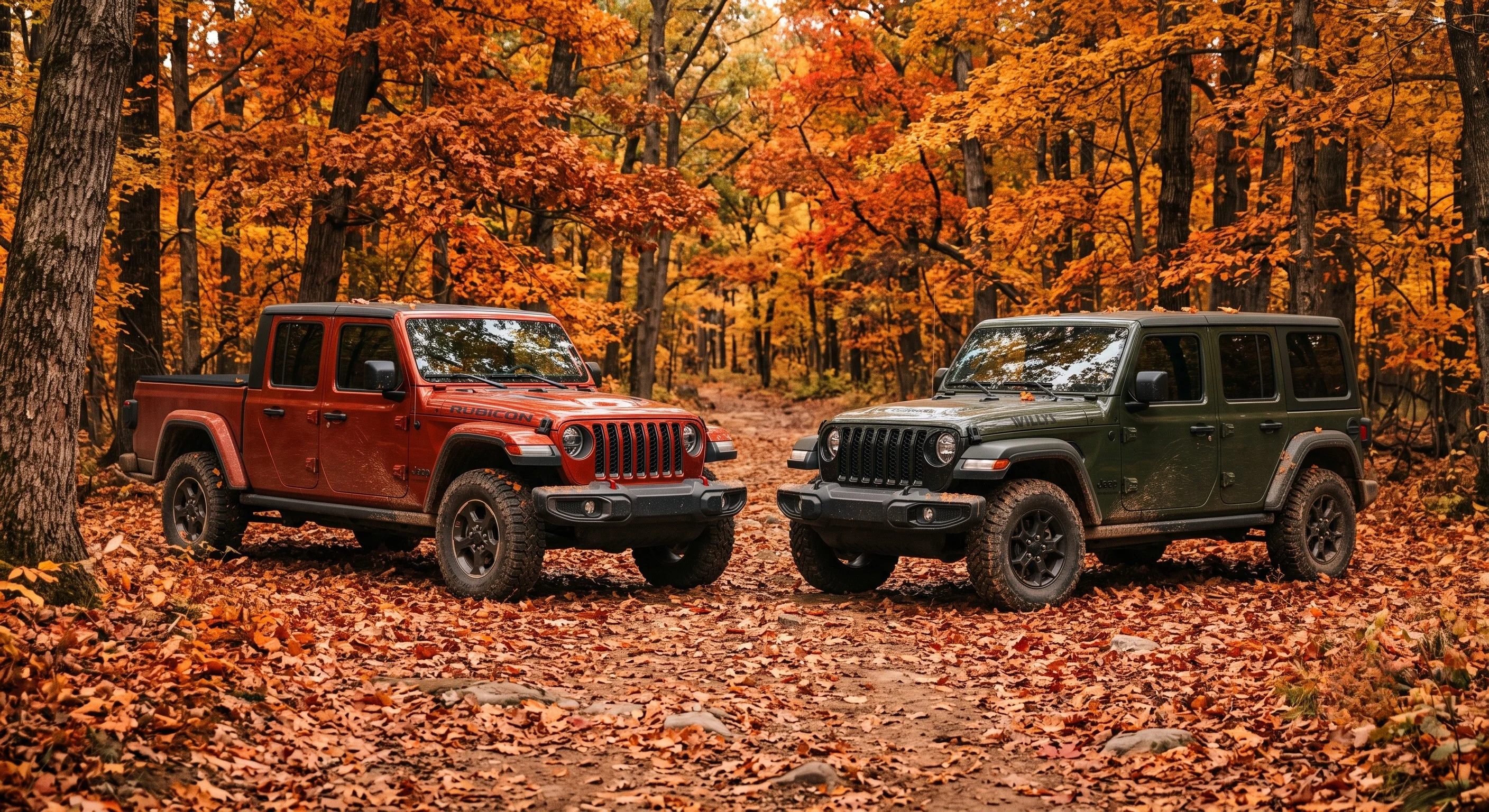
Many Fontana shoppers land between the tighter, more maneuverable footprint of the 2026 Jeep Wrangler and the haul-anything versatility of the Gladiator mid-size pickup. Both sit at the base of the San Gabriel Mountains’ foothill trails, and both deliver the same open-air experience — the decision is really about how you use the vehicle the other ninety percent of the time.
The Wrangler is the quintessential off-road SUV: a shorter wheelbase that carves tight trail turns and squeezes into compact parking spots, and a highly customizable platform for purists who want a weekend explorer that still works as a daily driver. The Gladiator takes that same fearless 4×4 formula and stretches it into a mid-size truck with a five-foot steel bed — built for buyers who need to haul mountain bikes, camping gear, or weekend project materials.
Both wear Jeep’s unmistakable design language, so neither model asks you to trade capability for style. The choice comes down to enclosed SUV packaging versus open-bed hauling and towing.
Side-by-Side: Gladiator vs. Wrangler at a Glance
| Spec | 2026 Jeep Gladiator | 2026 Jeep Wrangler (Two-Door) |
|---|---|---|
| Body style | Four-door crew cab with 5-ft steel bed (sole configuration) | Two-door SUV (also offered as four-door Unlimited) |
| Starting MSRP | Around $41,815 (Sport) | Around $36,890 (Sport) |
| Standard engine | 3.6L Pentastar V6 — 285 hp / 260 lb-ft | 3.6L Pentastar V6 — 285 hp / 260 lb-ft |
| Alternate engine | 3.6L V6 only (no alternate engine offered) | Available 2.0L turbo I4 — 270 hp / 295 lb-ft |
| Transmission | 8-speed automatic | 6-speed manual standard; 8-speed automatic available (required with the turbo) |
| Drivetrain | 4WD, part-time with 2-speed transfer case | 4WD, part-time with 2-speed transfer case |
| Seating | 5 | 4 (two-door); 5 (four-door) |
| Max towing (properly equipped) | Up to 7,700 lbs | 2,000 lbs (two-door); up to 3,500 lbs (four-door), up to 5,000 lbs on specific four-door configs |
| EPA-Estimated MPG | 17 city / 22 hwy / 19 combined | 20 city / 23 hwy / 21 combined (2.0L turbo, automatic) |
| Cargo | Open 5-ft steel bed, separate from the cabin | About 12.9 cu ft behind the rear seats (two-door) or 31.7 cu ft (four-door), expandable with seats folded |
| Infotainment | Standard 12.3" Uconnect 5, wireless Apple CarPlay & Android Auto | Standard 12.3" Uconnect 5, wireless Apple CarPlay & Android Auto |
Category leaders — Gladiator: towing, seating, open-bed hauling. Wrangler: starting price, fuel efficiency, maneuverability, engine choice. Tie: off-road heritage and standard 12.3" technology.
Manufacturer’s Suggested Retail Price (MSRP) for new vehicles includes manufacturer and distributor options and delivery, process and handling fees, which may be subject to change at any time. MSRP excludes taxes, title, license and dealer installed options, accessories, fees and charges. MSRP is not the dealer advertised price. Dealer price will vary. The dealer sets the final price.
Maximum towing and payload capacity figures are based on properly equipped vehicles and vary by configuration. Do not exceed any weight rating. See your owner’s manual and the vehicle’s door-jamb label for specific capacities.
EPA-estimated fuel economy figures are for comparison purposes only. Your actual mileage will vary depending on driving conditions, how you drive and maintain your vehicle, battery age/condition, and other factors.
Price and Value
The Wrangler opens lower — a two-door Sport starts around $36,890 MSRP, versus roughly $41,815 MSRP for the Gladiator Sport. That gap reflects what the Gladiator adds: a standard four-door crew cab and a real truck bed. Both lineups climb well into the $60,000 range at the top, where the Gladiator’s desert-tuned Mojave X sits near the summit. For a full trim-by-trim breakdown on the SUV side, see our 2026 Wrangler trim and pricing guide. If your budget is the priority and you don’t need a bed, the two-door Wrangler is the more affordable way into the Jeep 4×4 world; if you will use the utility, the Gladiator’s premium earns its keep.
Space and Practicality
For families and gear-haulers, the Gladiator is the practical pick. Every Gladiator is a four-door crew cab seating five, with usable rear legroom and a five-foot steel bed that keeps dirty or oversized cargo completely separate from the cabin. The two-door Wrangler seats four and offers about 12.9 cubic feet behind the rear seats — fine for couples and solo adventurers, expandable with the seats folded, but no match for an open pickup bed. If you want Wrangler practicality closer to the Gladiator’s, the four-door Unlimited adds a fifth seat and more room.
Performance
Both Jeeps share the proven 3.6L Pentastar V6 — 285 hp and 260 lb-ft — paired here with an 8-speed automatic and part-time 4WD. The Wrangler adds a choice the Gladiator does not: an available 2.0L turbocharged four-cylinder making 270 hp and a stronger 295 lb-ft of torque, with quick low-end response for rock crawling. The Wrangler’s shorter wheelbase makes it more agile on tight trails, while the Gladiator’s longer wheelbase rides more planted on the freeway. Where the Gladiator pulls clearly ahead is work: up to 7,700 lbs of towing when properly equipped, against 2,000 lbs for the two-door Wrangler.
Fuel Efficiency
Efficiency favors the Wrangler when it is equipped with the 2.0L turbo and 8-speed automatic — an EPA-Estimated 20 city / 23 hwy / 21 combined MPG, a sensible pick for a daily highway commute that still wants weekend capability. The Gladiator, heavier and built to haul, carries an EPA-Estimated 17 city / 22 hwy / 19 combined rating with its V6. It is a modest trade for the added utility if a bed and towing are part of your routine.
Technology and Safety
Both cabins center on a standard 12.3-inch Uconnect 5 touchscreen with wireless Apple CarPlay and Android Auto. Driver-assistance availability is similar across the two: Forward Collision Warning with active braking and Adaptive Cruise Control with Stop are standard from the Wrangler Sport S trim up (the base Sport adds them via package, and adaptive cruise requires the automatic transmission), and both models offer an available Active Safety Group that adds Blind Spot Monitoring with Rear Cross-Path Detection and rear park assist. Confirm the exact driver-assist equipment on any specific vehicle, since availability varies by trim and configuration.
Which Jeep Is Right for You?
Choose the Gladiator if you need genuine truck utility — a five-foot steel bed, five-passenger crew cab, and up to 7,700 lbs of towing (properly equipped) for a boat, camper, or utility trailer.
Choose the Wrangler if you want the lowest entry price, the most maneuverable footprint, the option of a more efficient turbo engine, and you don’t need a bed.
Either way, you are getting the same iconic 4×4 heritage — the difference is simply how you will use it. The best next step is time behind the wheel of both.
Frequently Asked Questions
Is the 2026 Jeep Gladiator worth the price premium over the Wrangler?
If you need truck utility, yes. The Gladiator starts around $41,815 MSRP versus roughly $36,890 MSRP for a two-door Wrangler, and that premium buys a five-foot steel bed, a five-passenger crew cab, and up to 7,700 lbs of towing when properly equipped — against 2,000 lbs for the two-door Wrangler. If you won’t use a bed, the Wrangler’s lower price is the better value.
Which vehicle has more usable cargo space for active families?
The Gladiator, for hauling. Its open five-foot steel bed carries dirty or oversized gear completely separate from the passenger cabin. The two-door Wrangler offers about 12.9 cubic feet behind the rear seats, expandable with the seats folded — workable for smaller loads, but it cannot match a pickup bed.
Explore more in our CDJR research hub.
Disclosures
Manufacturer’s Suggested Retail Price (MSRP) for new vehicles includes manufacturer and distributor options and delivery, process and handling fees, which may be subject to change at any time. MSRP excludes taxes, title, license and dealer installed options, accessories, fees and charges. MSRP is not the dealer advertised price. Dealer price will vary. The dealer sets the final price.
Maximum towing and payload capacity figures are based on properly equipped vehicles and vary by configuration. Do not exceed any weight rating. See your owner’s manual and the vehicle’s door-jamb label for specific capacities.
EPA-estimated fuel economy figures are for comparison purposes only. Your actual mileage will vary depending on driving conditions, how you drive and maintain your vehicle, battery age/condition, and other factors.